The Cannonball Run (1981)
The race from Darien, Connecticut, to Redondo Beach, California, is called the Cannonball Baker Sea-to-Shining Sea Memorial Trophy Dash, named after daredevil driver Erwin “Cannonball” Baker in the early 20th century.
This outlaw race stretched nearly 2,900 miles across the country. The record run was 32 hours and 51 minutes, averaging an insane 87 miles an hour. It started in 1971, when Brock Yates and Formula One star Dan Gurney won the very first one. In all, only five of these races were ever run.
Across those years, drivers racked up more than a hundred speeding tickets, but remarkably, there were no accidents involving innocent bystanders. The entries were as wild as the concept: in 1971, the Polish Racing Drivers of America showed up with a van carrying 300 gallons of fuel so they could drive nonstop—though one mistake could have turned them into a rolling fireball.
You had guys disguised as priests. You had upper-crust Brits being chauffeured in a Rolls-Royce Silver Wraith, complete with an elegant tea service. One winning team used a drive-away Cadillac that they were supposed to deliver four days later and just hung onto it until drop-off. And there was even a motor home that doubled as a rolling casino, hosting a coast-to-coast poker game along the way.
Brock Yates was a columnist for Car and Driver and an on-air commentator for CBS Motorsports.
The movie idea was born after a long night of drinking with Brock Yates. They dreamed up an ambulance running the race, figuring no cop would dare stop it. So they built one—a van stuffed with a Dodge performance engine.
Before this film, the idea of an illegal, cross-country car race had already appeared on screen in two earlier movies: The Gumball Rally (1976) and Cannonball (1976).
Both films center on coast-to-coast road races filled with eccentric drivers, high speeds, and comic chaos, helping to establish the template for the car-comedy/race genre.
- The Gumball Rally focused on a loosely organized underground race from New York to Los Angeles, played mostly for lighthearted fun and stunt driving.
- Cannonball, directed by Paul Bartel, took a grittier, more violent approach to much the same concept, also involving a cross-country outlaw race.
These two movies paved the way for the later film’s premise, but the later production added a broader ensemble cast, bigger stunts, and a more overtly comedic tone, building on the groundwork laid by The Gumball Rally and Cannonball.
On the real run, they did get pulled over in New Jersey, doing 120 miles an hour. They told the officers they had to keep driving because the woman in the back supposedly couldn’t fly due to a serious lung condition. The cops bought it and let them go—and a version of that exact moment ended up in the film.
The movie is based on a real Cannonball Run—the fifth and final one. Writer Brock Yates, director Hal Needham, Yates’s wife, and a wild doctor friend from UCLA actually drove an ambulance from Daytona Beach, Florida, to Long Beach, California.
They took a Dodge van ambulance, spent about $35,000 souping it up so it could hit 145 miles an hour and hold 90 gallons of gas. Since the race had no rules about what kind of vehicle you could use, Needham pitched the ambulance idea.
And it worked: whenever they hit traffic, they’d flip on the red lights, and the seas of cars would just part for them.
In 1979, Brock Yates and director Hal Needham entered the race in a fake ambulance that could hit 125 miles an hour. In the back, Yates’ wife Pamela played the role of a gravely ill patient, and they even hired a real doctor to ride along. His job was simple: if they got pulled over, he’d swear she had a rare lung disease and needed urgent treatment at UCLA in California.
They were convinced that if cops saw through the act, they were going straight to jail, so they committed fully to the story of a life-or-death medical run across the country. The ruse worked—but the machine didn’t. Near Palm Springs, the transmission gave out, and their high-speed “ambulance” had to bow out of the race.
Some of the movie’s other characters were lifted directly from that final real-life Cannonball Run. Yates and Needham handed out tape recorders, notepads, and pencils to the other racers and told them to jot down or record anything funny, strange, or memorable that happened on their cross-country drive.
A lot of that material made its way into the script. The guys disguised as priests? They were based on actual participants. And the two men on the motorcycle weren’t just made up for the film either—they came straight from real contestants in the race.
The movie takes significant liberties with what actually happened in the real Cannonball races. Some of the antics shown on screen simply wouldn’t be allowed—or tolerated—in the real event. For example, intentionally sabotaging another driver or their vehicle, as some characters do in the film, would cross a hard line. The real Cannonball was built around outlaw spirit, speed, and outsmarting the system, but there was still an underlying code of respect and responsibility among the participants. They were pushing limits, not trying to hurt each other or destroy competitors’ chances through direct interference. The film exaggerates these elements for comedic and dramatic effect, turning rivalries into slapstick and escalating conflicts to cartoonish extremes. In reality, while the race was certainly dangerous and illegal, it was never meant to be a demolition derby or a contest of who could be the most malicious—it was about endurance, navigation, stealth, and nerve, not sabotage.
One of the film’s funniest moments—when the ambulance is pulled over for speeding—is actually drawn from a real incident involving Hal Needham and Brock Yates. During the real Cannonball run, they were driving an ambulance and got stopped by the police.
To sell their cover story, they told the officers they were transporting a patient: Yates’s wife, strapped to a gurney in the back. They explained that she supposedly had a rare lung condition that made air travel impossible, and that she urgently needed treatment in California.
The officers bought the explanation. Instead of writing them up, they let the “medical transport” continue, issuing only a warning. The only condition was that they turn off the flashing beacons while driving through Pennsylvania.
That bizarre but successful bluff ended up inspiring the similar scene in the movie, blurring the line between the real Cannonball Run and its on-screen version.
In the real Cannonball run that inspired the film, the ambulance was actually on track to win the race outright. Needham and Yates had chosen it as the perfect disguise for high-speed cross-country travel, and the strategy was working. But near Palm Springs, the transmission failed, leaving the vehicle dead and knocking them out of contention just short of the finish.
Determined not to let their star vehicle simply disappear from the story, they hired a tow truck to haul the ambulance the rest of the way to Long Beach so it could still be present at the end of the race. That same ambulance later became a piece of film history: it was the very one used on screen in The Cannonball Run, turning their broken-down race entry into an iconic movie prop.
The script stayed dormant for 2.5 years without studio interest. Originally written for Steve McQueen as an epic, his declining health due to mesothelioma led to his decline.
Needham liked to say he’d never win an Oscar, but he’d be “a rich son of a bitch,” and that was what mattered to him. He thought directing was easy because he only made movies meant to be fun for the audience and for everyone on set. Any time a plot started getting too serious or complicated, he’d break it up with action or comedy.
His closest collaborator was Burt Reynolds, whom he considered both a mentor and a friend. They first met in 1957 on the TV pilot Riverboat, where Needham was hired as Reynolds’ stunt double. Reynolds wanted to do his own stunts, and Needham let him, figuring he’d still get paid without risking his neck. Eventually From then on, Needham didn’t want to work without him, and Reynolds appreciated that Needham’s movies were hits and that he shot quickly.
About a decade earlier, Needham had co-founded Stunts Unlimited with friends, a company that trained people from everyday jobs—like bartenders and roofers—to become stunt performers. The company made around $100,000 a year. As a second-unit director, he’d learned to be fast and prepared; if he wasn’t, his stunt would simply be cut. Producer Al Ruddy noticed how efficient and capable he was.
Needham treated his crews well, making sure they had the best food and accommodations, and in return, they stayed loyal and worked efficiently, knowing that speed meant more downtime. His directing debut, Smokey and the Bandit, became a massive hit, helped by Reynolds vouching for him. Thanks to a profit percentage, Needham made over $400,000 and went on to negotiate even better deals on later films. He shot Smokey in just 36 days and claimed he had no ego to get in the way of finishing a picture. Repeated injuries—two broken backs and nearly four dozen fractured bones—pushed him away from stunt work.
Needham had no problem making yet another movie with Burt Reynolds – four of his first five films already starred him. He joked that half the directors in the world were lined up, waiting for a chance to work with Reynolds. Beyond the star power, Needham said Reynolds was incredibly easy to work with: agreeable, hardworking, and one of the nicest people he knew. With that combination of talent, attitude, and friendship, Needham saw no reason not to keep teaming up with him.
Reynolds’ fourth collaboration with Needham was after Smokey and the Bandit, Hooper, and Smokey and the Bandit II. Reynolds was hard to secure because he still owed Paramount one more film in a three-picture contract, his dramedy Paternity. However, a loophole in his contract allowed him to be available before the specified date. Paramount threatened legal action, but their lawyer, a partner of the Cannonball Run producers’ lawyer, couldn’t sue without Ruddy and Needham’s written permission, which they refused. Paramount attempted to buy out the project, but failed. Later, after Ruddy and Needham agreed to be sued, 20th Century Fox paid Paramount $1 million to settle; the producers never paid anything.
After Burt Reynolds agreed to do it, studios that passed on it showed interest. The tone shifted to a broader farce. Yates believes that if kept as written, the film would have received better reviews but sold fewer tickets.
Reynolds asked that $1 million of his salary be donated to the Florida State University School of Theatre.
Burt Reynolds and Dom DeLuise’s on-screen chemistry in The Cannonball Run didn’t happen by accident—it came from a long-standing real-life friendship. The two had known each other for years before the film, and during that time, they developed an easy, instinctive comedic rhythm that carried straight into their performances. Their banter, timing, and the way Burt played the straight man to Dom’s more chaotic energy all felt effortless because it was essentially an extension of how they interacted off camera. DeLuise even told producer Albert S. Ruddy that he was “the one who makes Burt funny,” underscoring how much he saw his role as unlocking and amplifying Reynolds’ comedic side. That dynamic became a key part of the film’s charm, with many moments between them feeling less like scripted comedy and more like two old friends goofing around in front of a rolling camera.
Producer Albert Ruddy later admitted they chased product tie-ins anywhere they could find them, and they paid off. He estimates those deals alone brought in between $2.5 and $3 million. One of the biggest was with 7-Eleven, which kicked in about half a million dollars on the condition that Burt Reynolds be shown stopping at one of their stores for gas. At the time, a lot of people didn’t even realize 7-Eleven sold gasoline, so the company saw the movie as a chance to change that image.
The promotion didn’t stop on screen. 7-Eleven also rolled out a massive Slurpee campaign: 25 million cups printed with the faces of The Cannonball Run’s stars. Those cups turned into instant collectibles, disappearing from stores almost as soon as they arrived and becoming one more way the film turned hype into real money.
Needham coordinated with Golden Harvest, needing more funds for cars and top actors. He knew little of Jackie Chan and initially didn’t involve him much physically. Yet, once he realized Jackie’s abilities, he let him choreograph fights. Jackie wanted a month to craft complex sequences, which Needham couldn’t approve due to time constraints and his lower star status. Jackie also needed a dialogue coach to improve his limited English. While others relaxed in trailers, Jackie observed the shoot to learn about Hollywood filmmaking.
Reynolds wanted Sammy Davis Jr. as the comic foil because he was the complete opposite of Dom DeLuise—skinny instead of portly, Black instead of Italian, but just as wildly talented. Sammy did for Dean Martin what Reynolds did for DeLuise: he pushed him to go bigger, go wilder, and tried to crack him up on every take. Davis was always on, always ready to entertain.
Sammy Davis Jr. was performing with Dean Martin in Las Vegas when he was approached about doing the film. It was his first movie role in two years, but he didn’t need the work—he was one of Vegas’s highest-paid entertainers, earning six figures a week. He agreed to join mainly because Burt Reynolds was already attached, which signaled to him that it was a legitimate project, and because it sounded like a lot of fun.
Dean Martin was in declining health at the time of The Cannonball Run, but the chance to work with his longtime friend Sammy Davis Jr. turned the shoot into a kind of joyful break from his troubles. On set and off, the two of them spent their time joking, riffing, and making each other laugh, and that easy camaraderie fed directly into their scenes together. Martin had always been the filmmakers’ first choice for the role, but getting him to sign on wasn’t simple. His agent repeatedly pushed back, saying that Martin didn’t feel any need to take on more work at that stage of his life and career. Producer Albert S. Ruddy had to be patient and strategic, waiting until the circumstances were just right before bringing the idea to Martin himself. When he finally did, the timing and the appeal of teaming with Sammy helped win Martin over, giving the film one of its most memorable comic pairings.
Once filming began, Davis and the others realized that no one had actually informed them of their payment or billing arrangements. The production felt even wilder than the movies he’d made in the 1960s—there didn’t seem to be any real rules. It reminded him of the film he’d done with Frank Sinatra, where half the dialogue seemed ad-libbed, and everyone just enjoyed themselves.
On this set, he’d show up expecting an easy day, only to be told the writers were still working on his scenes and that he’d have to memorize two pages of fresh dialogue on the spot. Many of the performers shared the same frustrations: they were often flown in for what was supposed to be a quick shoot, woken at 4:30 in the morning, and then never actually used on camera that day.
This was the fifth film pairing of Dean Martin and Sammy Davis Jr. and Martin, by most accounts, wasn’t just playing a drunk. Crew members remembered him walking around with a glass of whiskey in his hand pretty much all day. Before each scene, he’d simply ask the director one question: “Can I drink or smoke in this one?”
During filming, the set often turned into a rolling party. Many of the actors would end up packed into Dean Martin’s trailer, drinking and joking between setups. After the day’s work wrapped, the core group usually migrated to Burt Reynolds’s hotel suite, where the real late-night sessions began.
They’d stay up talking and laughing until three in the morning, trading stories from their careers and pulling each other into one-upmanship routines. That’s when Sammy Davis Jr. would really light up—he’d start singing for his friends, turning the room into a private Rat Pack-style show.
Sammy later said it was the most fun he’d had on a movie since the old Rat Pack pictures, a last blast of that loose, anything-can-happen energy that had defined an earlier era in Hollywood.
The Atlanta crowds turned out to be too much for Farrah Fawcett. She bowed out of the chaos, flew back to California, and only then agreed to shoot her scenes there instead.
Peter Fonda shows up in a brief cameo as the leader of a biker gang, a playful nod to his iconic role in Easy Rider. The part was created specifically for him after Fonda heard about the production and asked cameraman Michael Butler to help him get involved in the movie.
For the film’s wild airplane gag, the production needed more than just daring stunt work—they needed political approval. The filmmakers actually obtained permission from Florida Governor Bob Graham (sometimes misremembered or misstated as “Busby”) to land a plane in a small town, an unusual and risky setup that required official sign-off for safety and legal reasons.
Originally, the governor was so enthusiastic about the idea that he was slated to land the plane himself as part of the stunt. That plan would have added a unique cameo and a layer of real-world novelty to the sequence. However, for practical and safety reasons, the production ultimately relied on professionals to handle the landing, keeping the scene dramatic and believable while avoiding unnecessary risk.
Still, the fact that a sitting governor was initially willing to be directly involved shows how much excitement and goodwill surrounded the production, and how far the filmmakers were willing to go to make the movie’s outrageous set pieces feel real.
During a stunt sequence on a desert highway near Boulder City, Nevada, a serious accident left four people injured, two of them critically. A van collided head-on with an out-of-control car made to look like a 1961 Aston Martin. That stunt car had been weaving between five other vehicles when the driver felt it was about to roll, veered off the road, and instead slammed into the van. The car burst into flames on impact.
Inside that Aston Martin replica was stuntwoman and former champion skier Heidi Von Beltz, doubling for Farrah Fawcett and other stars. She suffered a broken neck, spent seven months in the hospital, and was left a quadriplegic at just 22. Von Beltz sued Burt Reynolds, director Hal Needham, producer Al Ruddy, Golden Harvest’s Raymond Chow, driver Jimmy Nickerson, and two auto companies for $35 million, arguing through her attorney Melvin Belli that the stunt was poorly designed and the car had been modified in unsafe ways. The case didn’t go to trial until 1986 and drew major media attention because of its potential impact on Hollywood stunt work. The first jury deadlocked, but a second jury awarded her $7 million, later reduced to $4.5 million after she was found partially at fault. In time, Von Beltz regained limited use of her arms and some sensation in her legs.
Reynolds said being on set felt like one long, “terrific party.” He joked that if adulthood meant anything other than having that much fun every day, then he never wanted to grow up.
For the film’s end-title song, the producers originally hoped to have The Carpenters perform it, figuring their smooth, melodic style would give the movie a warm, polished send-off. However, when they looked into it, the cost of hiring The Carpenters turned out to be far beyond the film’s music budget. Rather than abandon the idea of a distinctive vocal performance, they pivoted to a far more economical solution. They brought in the California Children’s Chorus, who agreed to record the song for a fraction of the price—almost nothing in comparison. The result was a different tone than originally imagined, but the children’s voices gave the ending a lighter, more innocent, and slightly whimsical feel that contrasted nicely with the movie’s high-speed antics and broad comedy, while also solving a very practical budget problem.
The first preview audience cheered with joy at the opening credits, considering the number and quality of stars in one film.
The film’s release date was pushed back twice—first to avoid opening against Seems Like Old Times, and then again to steer clear of competition from The Blue Lagoon.
Jackie Chan agreed to this tiny role for one big reason: visibility. He knew The Cannonball Run would pull in a huge mainstream American audience, and he treated it like an audition for Hollywood. If he could just do something memorable, maybe those viewers would be curious enough to follow him to a future starring role.
But what ended up on screen is… odd. Chan is introduced as a Japanese driver, yet he’s clearly speaking Cantonese the entire time. The movie doesn’t explain it, no one comments on it—it just sits there as this bizarre cultural mix-up. It’s a small part, but it perfectly captures where Jackie Chan’s career was at that moment: right on the edge of breaking into America, but still being badly misunderstood.
A lot of the big names in The Cannonball Run actually breezed through the shoot. Most of the stars were on set for just two or three days, maybe up to a week if they had more to do. The production only needed them together for the opening and closing sections. In between, they shot their scenes separately, each doing their own bits while the rest of the ensemble cycled in and out. It gives the whole film this loose, patchwork feel—like a rotating comedy carnival where the leads keep popping back in to hold the thing together.
Hal Needham’s decision to roll bloopers over the end credits didn’t just get a few laughs—it left a real mark on Jackie Chan. That idea stuck with him. Starting with 1982’s Dragon Lord, Jackie began ending his own movies the same way, but with his own twist.
Instead of flubbed lines and goofy mistakes, his outtakes focused on the painful reality behind the action: stunts gone wrong, mistimed jumps, and the injuries he and his team took along the way.
Those credit sequences became a kind of signature for Jackie Chan films—proof that the wild stuff you’d just watched wasn’t camera trickery, but hard-earned, often dangerous work.
Farrah Fawcett plays an environmentalist out to stop the race.
Hal Needham was romantically involved with actress Dani Janssen during this time. Al Ruddy was also set to marry Los Angeles Herald Examiner society editor Wanda McDaniel on June 21, two days after the release of Cannonball. Needham was scheduled to marry Janssen a week later.
Needham and Ruddy were set to work on another film together immediately afterward, a contemporary Western called The Texans, had the July 1 directors’ strike not occurred.
The release date was one week before Roger Moore’s Bond film, For Your Eyes Only. The producers were disappointed because interviews with greater concentration were more about 007 than about Cannonball.
The Loganville, Georgia, 30-acre mansion estate of Carl Newton, known as Marrimont, passed through the one that belonged to a deceased girdle manufacturer in Beverly Hills. Burt Reynolds became so enamored of the place after staying there for three weeks during the shoot that he decided to buy it. He said he liked that it was quiet and peaceful, and that no one bothered him. He considered Georgia his “good luck state.
Jackie Chan was Asia’s top action star, and Michael Hui was their top comedian. Golden Harvest scheduled his appearance, telling him the part was small and it wasn’t an action film, so that he could concentrate on his acting. “Cannonball” was Jackie’s childhood nickname because when he was born, he was large and round, which he took as a good sign. Jackie wasn’t comfortable playing a Japanese character, but by the time he took on the role, it was already set in stone. The Hollywood stars were polite and said hello casually when they saw him, but few stopped to say more. He gathered that none of them knew who he was. In Hong Kong, he was the biggest fish in a small pond, but the smallest in a big pond in America. His speaking role was minimal; most days, he wasn’t used, and when he was, it was to make a silly face, which he didn’t understand since he didn’t know much English. Eventually, he sat on the sidelines and sulked without talking to anyone all day.
Because he was playing a character, most of the people on the set assumed Jackie was Japanese. Sammy Davis Jr. tried to converse despite the language barrier, saying he’d just come from Japan and that he knew he was huge there. After Jackie corrected him by saying he’s from Hong Kong, not Japan, Sammy retorted casually, “Oh, right, a Hong Konger. Sayonara!’ Not that telling his fellow actors he was from Hong Kong meant much. Some assumed Hong Kong was in Japan, while others were unaware of the significant differences and perceived Japan, China, Korea, and Hong Kong as a monoculture.
Golden Harvest also wanted to cast their other Hong Kong superstar, Michael Hui, to guarantee the film could be sold in Asia, where it did very well, especially in Japan. However, it wasn’t well received in Hong Kong because audiences there didn’t want to see an ensemble of mostly American actors, especially one in which the Asian actors looked like buffoons. However, their billing was near the bottom in America, if they were credited in ads or on posters at all. Jackie said he was treated well by the rest of the cast in a very phony, Hollywood way – cordiality but zero interest in him. Sammy Davis would call out, “Gozaimas” to Jackie, thinking it meant “Good morning” in Japanese. When Jackie told him he was Chinese, Sammy said, “Right, babe, Chinese. Sayonara!” Eventually, Jackie became antisocial, making excuses not to talk, and others began leaving him alone.
Most of the East Coast locations were in and around Atlanta, while the majority of the other places were in Arizona, with key scenes also filmed in Las Vegas and California.
The wheelie king could ride doing a wheelie as far as necessary, even a mile or two if needed.
They contemplated including a scene where Fenderbaum (Sammy Davis Jr.) encounters members of the KKK and is saved by J.J., but Burt thought it was pushing things too far. These Southern boys were the audience he’d built with Smokey and the Bandit, and he didn’t want to provoke them.
The Ferrari that Dean and Sammy drive was Needham’s own. Needham included it in the film so the production would pay to move it to different locations, allowing him to drive when it wasn’t time to film.
Mel Tillis and Terry Bradshaw were so funny. Needham had an idea to produce a TV pilot for a potential series with them, but the network’s head was fired just days before they were set to film, and the idea was scrapped. NBC chopped the pilot down to 30 minutes and released it without much fanfare. The butchered show, and Bradshaw felt embarrassed, not only because it was bad, but that he’dupset so many with premature threats of retirement. It needed to draw a 22 share, but only got a 14.
Bradshaw was making $250,000 putting his neck on the line as the quarterback for the Pittsburgh Steelers. He made $150,000 for a couple of weeks of comic acting for Cannonball Run. Bradshaw was not looking forward to the downslope of his football career, and if there was a chance to make more money acting, he wanted to do it. If the “Stockers” pilot was successful, he would announce his football career as officially over. The move agitated the Steelers organization and the fans, who felt Bradshaw was deserting them. Bradshaw felt he’d done so much for them that he needed to do something for himself, and this would allow him to move back to the South, where he was happiest.
Reynolds was going through a highly publicized breakup with Sally Field at the time.
The project was kicked back to Needham for re-editing.
In the editing room, every time they cut to Terry Bradshaw and Mel Tillis, they fell out of their chairs laughing. This was NBC’s answer to “The Dukes of Hazzard”; the kind of good-ol-boy interplay that was dominating TV shows in the wake of the success of their own Smokey and the Bandit. They took all the footage they could to John McMahon, president of Johnny Carson Productions, who took it to NBC. Terry Bradshaw also began shooting a two-hour movie pilot for a proposed new TV comedy series called “The Stockers, playing driver JJ Spangler and mechanic Curtis Whitcomb. about two struggling stock-car racers competing in minor-league dirt track racing, for Johnny Carson Productions. It promised to be their first production. NBC Entertainment President Brandon Tartikoff greenlit the project after Hal Needham brought in twenty minutes of footage featuring Tillis and Bradshaw from The Cannonball Run to a meeting with NBC execs. They found it energetic, humorous, and charming. The comedic chemistry between the two novice actors was palpable. Needham was set to direct, and Al Ruddy to produce. Questions abounded about whether Bradshaw could sustain a TV series while still playing football. The pilot debuted on May 1, 1981.
Needham knew Roger Moore because his ex-wife used to throw many parties at the house, inviting numerous celebrities, and Moore had attended on several occasions, getting to know the Needhams. Needham and Ruddy thought Moore would be a brilliant addition to open the film to international markets familiar with James Bond. Moore agreed to a lower salary for a percentage of the profits. Burt Reynolds liked the ranch used as Moore’s home in the film so much that he bought it and installed a couple to take care of it so he’d have a retreat near Atlanta. The initial idea was for Moore to play a superspy exactly like James Bond, except in name. To avoid a lawsuit, they had to alter the script so that the character was named Seymour Goldfarb, who wanted to be Roger Moore, rather than Roger Moore wishing to be a James Bond clone. Needham was also a close friend of Bond film producer Albert Broccoli; there was too much to risk displeasing him. In Moore’s future contracts for subsequent Bond films, a stringent clause was included that forbade him from spoofing the series because of his involvement in this film. Moore had recently announced that he would not likely continue as James Bond in the real 007 series because of a dispute with the producers, who were auditioning other actors during contract negotiations for For Your Eyes Only, and Moore did not feel he needed to compete for the job.
When the script was shopped around, they had difficulty finding actors interested in it because the screenplay didn’t appeal to them. Hal Needham was working with Burt Reynolds on Smokey and the Bandit II when producer Albert Ruddy decided to ask Raymond Chow of Golden Harvest if they could secure Burt for $5 million, the highest payday for any actor on any film to date, for only four weeks of work. Burt had initially turned down the project because he’d just made a string of similar car chase movies and didn’t want to jump into another one. He had appeared in the acclaimed film Coming Home and wanted to make another prestige film to prove he was a good actor. Unfortunately, the scripts like Kramer vs. Kramer weren’t coming his way.
Burt also had problems with the early script. He said the film wouldn’t work as it was. For instance, he said, the character of his sidekick wouldn’t work unless he had an alter ego, and even then, it would take someone like Dom DeLuise to play him. He also suggested having a James Bond type played by Roger Moore himself, but the character wouldn’t be Roger Moore – just someone who believed he was him. They made all the changes he suggested, and before he knew it, he felt invested in seeing them come to life. And it sounded like it might be a lot of fun. Altogether, Moore shot all of his scenes in a week.
Farrah Fawcett received a Worst Supporting Actress nomination at the Golden Raspberry Awards (Razzies).
As Needham discussed with Burt, they would send him a revised script. Burt said they didn’t need to send a script if they were going to pay him $5 million for a month’s work. He said, while it might seem immoral for anyone to make that kind of money for so little time, it would be even more sinful to turn it down. The producers said the $5 million was a bargain because, as with Marlon Brando’s high salary for signing on to The Godfather, other big names would readily sign on for peanuts just for the chance to work with him. The film’s total budget was $13 million, but it ended up costing $17 million. Not that they were concerned; they estimated that the film could surpass $250 million worldwide.
The part of the Vegas gambler posing as a priest, Fenderbaum, was initially intended for Don Rickles. However, Rickles declined the offer because he felt he was a bigger name and drew a bigger following than Dom DeLuise, who had a higher billing position and was paid more, so he refused to do it. They then cast Sammy Davis Jr., but still kept the Jewish surname.
Critics despised The Cannonball Run, calling it tasteless and mindless. Some also called it racist, sexist, and antisemitic. But summertime drive-in moviegoers enjoyed it as a fun diversion. It raked in over $70 million at the North American box office and added about that much more internationally.
Cannonball Run was a childhood favorite of mine and is one of my all-time guilty pleasures. The reason I like the film doesn’t stem from the usual things — I am not a fan of any of the actors (except Jackie Chan), and I don’t think it’s particularly brilliant in the writing or direction department. The car chases are certainly not particularly appealing to me. What this movie has is oodles of cast chemistry, and it’s very clear that the entire cast and crew enjoyed making it, with almost everyone looking like they are on the verge of laughter throughout the film (the end-of-film bloopers bear this out). It’s also an inspired idea for a movie based on an actual race that took place in the 1970s (reportedly initiated by screenwriter Yates), and the plethora of colorful characters interacting with each other proves to be great fun.
Burt Reynolds stars as J.J. McClure, a thrill-seeker who decides to enter an illegal coast-to-coast car race that draws in contestants from all around the world. It’s dog-eat-dog, as the contestants do everything they can to be the first to cross the finish line while also trying to avoid getting in trouble from the highway patrol along the way.
It’s nothing too deep, but it doesn’t try to be. Cannonball Run is a pure entertainment movie that delivers the goods for anyone seeking a few chuckles and goofy characters to follow. The multitudinous character actors are a joy to watch, with solid chemistry between the chosen partners, especially the Reynolds/DeLuise and Dean Martin/Sammy Davis Jr. combos. This also marks the first American film appearance of future world action superstar Jackie Chan, playing a Japanese race driver who speaks Cantonese (Jackie reportedly is upset at not being informed of this). Jackie was told he wouldn’t have to worry about action or memorizing English lines and could just be himself, but that was far from the truth. What he was told he would do was just make funny faces and a little bit of fighting, but it was nothing that required much skill. Many could have played such a role; it didn’t need someone like Jackie to portray. Fun is also had watching Roger Moore spoof his James Bond image, with some homages to the gadgets featured in the films themselves. On the downside, this is not a film that will earn many points from the politically correct crowd.
With excellent stunt work, an impressive cast, and a heaping helping of fun, Cannonball Run is an entertaining 90 minutes for those who expect hot cars, hotter women, and lots of crazy set pieces. Not a hit with critics, this is fan-favorite material all the way.
Qwipster’s rating: A-
MPAA Rated: PG for language, mild violence, and sexual innuendo (probably PG-13 today)
Running Time: 95 min.
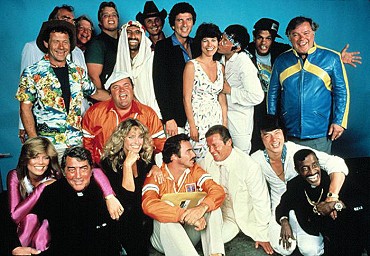
Cast: Burt Reynolds, Dom DeLuise, Farrah Fawcett, Roger Moore, George Furth, Sammy Davis Jr., Dean Martin, Jackie Chan, Bert Convy, Jack Elam, Jamie Farr, Adrienne Barbeau, Terry Bradshaw, Mel Tillis
Director: Hal Needham
Screenplay: Brock Yates