
The Cannonball Run (1981)
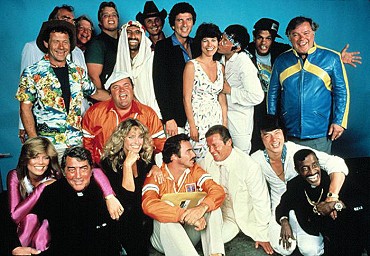
The Cannonball Run isn’t traditionally a great film. It’s loose, chaotic, silly, and filled with jokes and stereotypes that haven’t aged well. Critics were right to call it tasteless, mindless, sexist, racist, antisemitic, and dumb. But audiences of its time loved it. It earned more than $70 million in North America and roughly the same amount internationally. It became a summer crowd-pleaser, a drive-in favorite, a cable-TV staple, and for a certain generation, a strange kind of comfort movie: not brilliant, not defensible in every moment, but still weirdly appealing.
The film’s central idea was not invented by Hollywood. The illegal coast-to-coast race at the heart of the movie came from the Cannonball Baker Sea-to-Shining Sea Memorial Trophy Dash, named after daredevil driver Erwin “Cannonball” Baker. The race ran from Darien, Connecticut, to Redondo Beach, California — nearly 2,900 miles of public roads, traffic, police risk, gas stops, and nerve.
There were no closed courses or formal permissions—just a start, finish, stopwatch, and a bold belief that if you were clever, fast, prepared, and lucky, you could cross America faster than anyone else.
The Cannonball began in 1971, when Car and Driver columnist and CBS Motorsports commentator Brock Yates teamed with Formula One legend Dan Gurney. They won the first race. Only five official Cannonball runs happened before the film arrived, and the fastest recorded time was 32 hours and 51 minutes — an average of roughly 87 miles per hour across the country, including fuel stops, cities, traffic, and police encounters.
During the Cannonball years, drivers received over 100 speeding tickets, but remarkably, no accidents involving bystanders occurred. This highlights the difference between the real race and the movie version. The real Cannonball was illegal, dangerous, arrogant, and not something to imitate. It had a code centered around speed, endurance, navigation, nerve, mechanical preparation, and outsmarting the system. It was not a demolition derby, nor was it intended to harm other teams. The movie transforms the event into cartoon warfare, with characters tricking, sabotaging, distracting, and interfering with each other as if in a live-action Wacky Races. This broadens the comedy but alters the spirit of the real event.
The real Cannonball was already mythic, with wild entries like men disguised as priests, upper-class Brits in a Rolls-Royce, a Cadillac winning an outlaw race, and a rolling casino for coast-to-coast poker. When people say The Cannonball Run is ridiculous, they’re right, but the story was absurd before Hollywood touched it.
In 1976, The Gumball Rally and Cannonball used similar ideas—one humorous, the other darker. These films set the template. The Cannonball Run didn’t invent outlaw race comedies but amplified them with a bigger cast, more jokes, more stunts, more marketing, and Burt Reynolds, making it feel like a celebrity party.
Brock Yates bridged the real Cannonball and the movie. He helped create the race, participated in it, and wrote its screenplay. The movie’s famous ambulance gag started as a real Cannonball strategy—Yates and director Hal Needham devised it one night, thinking: who would stop an ambulance? They built a Dodge van with a performance engine, capable of 125-145 mph, and 90 gallons of fuel, then entered it in the 1979 Cannonball. The team—Yates, Needham, Yates’s wife Pamela, and Lyle Royer, a radiologist from Los Angeles—drove from Daytona Beach to Long Beach. Pamela pretended to be seriously ill, claiming she had a rare lung disease, so the ambulance had to make the run since she couldn’t fly. They knew they could be arrested, but fully committed, flipping on red lights and watching cars part. Police in New Jersey stopped them at 120 mph, bought the story, and let them go. Near Palm Springs, a transmission failure ended their run, but the ambulance was towed to Long Beach to appear at the finish line. Later, it appeared in The Cannonball Run as a real outlaw race vehicle.
That story also tells you almost everything you need to know about Hal Needham. Needham was not an art-film director. He came from the stunt world, co-founded Stunts Unlimited, trained stunt performers, broke his body repeatedly, and later became a director. As a second-unit director, he prioritized speed, practicality, preparation, and loyalty. He treated crews well because he knew they worked better when respected. His style was fast, loose, physical, and unpretentious. He preferred movies that were fun for audiences and creators, with action, comedy, momentum, and personalities, rather than heavy plots.
His first feature, Smokey and the Bandit, was a huge success. Shot in 36 days, it earned Needham over $400,000 and proved the commercial power of his formula. His top asset was Burt Reynolds. Needham and Reynolds met in 1957 on Riverboat, where Needham was Reynolds’s stunt double. Reynolds, eager to do his own stunts, formed a friendship and partnership that shaped both of their careers. By the time The Cannonball Run came out, they had already worked on Smokey and the Bandit, Hooper, and Smokey and the Bandit II; The Cannonball Run was their fourth collaboration. Needham loved working with Reynolds, describing him as easygoing, hardworking, and agreeable, and as one of the nicest people he knew. More importantly, Reynolds was box office; half of Hollywood’s directors wanted him, and Needham had him.
The Cannonball Run faced delays and sat unsold for 2.5 years. It was initially a larger project with Steve McQueen, but his ailing health led him to decline, making it harder to sell the race movie.
Producer Albert S. Ruddy and Hal Needham decided to get Burt Reynolds. Initially, Reynolds refused, seeking another serious role after Coming Home rather than another car-chase comedy like Cannonball Run. Ruddy and Needham, with Raymond Chow’s Golden Harvest, offered him $5 million for four weeks—at the time, a record for such a short shoot. Reynolds joked about the pay being immoral, but equally immoral to refuse. For the producers, Burt’s salary was a strategy: like Marlon Brando in The Godfather, Reynolds casting could attract other celebrities for less. The budget rose from $13 million to $17 million, but producers believed the film could earn over $250 million worldwide. Burt Reynolds was key to the project’s success.
Reynolds also helped reshape the film. He felt the script would not work as written. He suggested giving his sidekick an alter ego, which became Dom DeLuise’s Captain Chaos. He also proposed bringing in Roger Moore to play a James Bond-like figure — not literally James Bond, but a man who thought he was Roger Moore.
Those changes pushed the movie away from a more serious or epic racing story and toward broad farce. Brock Yates later believed that if the script had stayed closer to its original form, critics might have been kinder, but ticket sales probably would have been lower. Nevertheless, he remained unhappy with how it turned out, despite its success, because Reynolds came on board and immediately butchered everything that he felt gave the story merit. Worse, despite a varied career, the movie seems to have defined him, as it is what most people choose to talk about when they engage with him.
Reynolds’s participation also created legal chaos. He still owed Paramount one more film, Paternity, but a scheduling loophole appeared to make him available early. Paramount threatened legal action. The situation became absurdly tangled because Paramount’s lawyer was partnered with the Cannonball producers’ lawyer, who could not sue without Ruddy and Needham’s written permission, which they refused to give.
Paramount tried to buy the project and failed. Eventually, after Ruddy and Needham agreed to be sued, 20th Century Fox paid Paramount $1 million to settle the dispute. Ruddy and Needham paid nothing.
Reynolds also asked that $1 million of his salary be donated to the Florida State University School of Theatre.
If the movie has a comic engine, it is Reynolds and DeLuise. Their chemistry came from a real friendship. Burt was cool, relaxed, and sly. Dom was the chaos machine. Reynolds would smirk and underplay while DeLuise erupted around him. DeLuise knew how to make Burt laugh, and he once told producer Albert Ruddy that he was “the one who makes Burt funny.” Reynolds named DeLuise’s character Victor Prinzim in honor of his real-life friend and former Florida State Seminoles football team quarterback, Victor Prinzi.
Their scenes often feel less like scripted comedy and more like two friends trying to crack each other up. That warmth gives the film a pulse that the screenplay does not always provide.
Dean Martin and Sammy Davis Jr. bring a different kind of chemistry as fake priests driving a Ferrari. The Vegas gambler priest role had originally been intended for Don Rickles, who declined. Rickles reportedly believed he was more famous and had a bigger following than Dom DeLuise, who had higher billing and was paid more. Sammy Davis Jr. got the part instead, keeping his Jewish surname.
Reynolds liked Sammy as the comic foil because he was the opposite of DeLuise: skinny, Black, and wildly talented. Sammy did for Dean Martin what Burt did for Dom — he pushed him to go bigger.
Sammy, who was performing with Martin in Las Vegas, did not need the work. He was earning six figures a week. But Burt Reynolds’s attachment to the project made it feel legitimate, and it sounded fun to workk with Dean Martin again. Martin, whose health was declining, found working with Sammy again a respite from his woes. This was their fifth film together, and their history shows.
Martin was not hard to cast because the filmmakers doubted him. He was hard to get because his agent said he did not need more work. Ruddy waited for the right moment to approach Martin personally, and the chance to work with Sammy sealed it.
The set, by many accounts, felt like a rolling party. Actors gathered in Dean’s trailer, drinking and joking, then moved to Burt Reynolds’s suite for late-night stories and singing. Sammy said it was the most fun he had enjoyed since the old Rat Pack days.
But the looseness came at a cost. Nobody seemed entirely clear about billing or payment. Performers waited around, learned new lines at the last minute, or flew in for quick shoots only to be unused that day. The movie may have looked like a party, but behind the scenes, it was a logistical mess.
One proposed scene would have pushed the film into uglier territory. It involved Fenderbaum encountering KKK members and being rescued by J.J. Burt. Reynolds thought it went too far and worried about alienating his Southern audience, so the scene was dropped.
Roger Moore’s role was the result of stunt casting. Needham knew Moore socially, and Moore agreed to work for a lower salary in exchange for a share of the profits. The original idea was to let him play a Bond-like superspy, but legal concerns involving Bond producer Albert “Cubby” Broccoli forced a change. Instead, Moore played Seymour Goldfarb, a man who wants to be Roger Moore.
That made the joke even stranger: Moore was not exactly spoofing James Bond; he was spoofing the public image of Roger Moore as James Bond. His scenes were shot in about a week, amid disputes over whether he would continue as Bond. The Cannonball Run opened one week before For Your Eyes Only, which drew media attention and reportedly contributed to stricter future Bond contracts limiting this kind of spoofing.
Jackie Chan’s involvement is historically important and culturally awkward. Today, he is a global action icon. In 1981, he was already a major star in Asia but still unknown to most American audiences. Golden Harvest put him in The Cannonball Run to boost Asian sales and give him U.S. exposure. He accepted the role, hoping it would introduce him to Hollywood.
Instead, he was cast as a Japanese race driver, despite being from Hong Kong and speaking Cantonese. Jackie was uncomfortable with the cultural mismatch, but the role was set. Many people on set assumed he was Japanese. Sammy Davis Jr., trying to be friendly, told Jackie he had just come from Japan and knew Jackie was big there. Jackie corrected him: he was from Hong Kong. Sammy responded, “Oh, right, a Hong Konger. Sayonara!” In another version, Sammy called out “Gozaimas,” thinking it meant good morning in Japanese. Jackie said he was Chinese, and Sammy replied, “Right, babe, Chinese. Sayonara!”
Jackie felt politely dismissed in America. In Hong Kong, he was a major star. In Hollywood, he was treated like a novelty. His role gave him little to do beyond making faces, handling limited dialogue with a coach, and participating in simple fights. Needham did not initially understand what Jackie could do, though he eventually let him choreograph some fight material. Jackie wanted more time for complex action, but his status in the production limited him.
Golden Harvest’s plan worked commercially in some Asian markets, especially Japan, but the response in Hong Kong was tepid. Audiences there did not love seeing Jackie Chan and Michael Hui, major stars at home, reduced to foolish side characters in an American ensemble.
Still, Jackie took one major lesson from the film. Hal Needham’s end-credit bloopers inspired Jackie to use outtakes in his own movies, showing real stunts, mistakes, pain, and danger. That became one of his trademarks. So even a frustrating Hollywood experience gave him something lasting.
Farrah Fawcett, then a major star and known environmentalist, played the environmentalist trying to stop the race. The role did not earn critical respect and brought her a Golden Raspberry Award nomination. Crowds in Atlanta became overwhelming, so she left, returned to California, and filmed her remaining scenes there.
Peter Fonda appears briefly as a biker gang leader, a wink at Easy Rider. The part was created after he heard about the production and asked cameraman Michael Butler to help get him involved.
Terry Bradshaw and Mel Tillis had enough chemistry for Needham to think they could carry their own project. During editing, footage of them laughing was shown to John McMahon, who took it to NBC. Brandon Tartikoff approved a pilot called The Stockers, starring Bradshaw as driver J.J. Spangler and Tillis as mechanic Curtis Whitcomb. Needham was to direct, Ruddy to produce. Bradshaw, who earned $150,000 from acting, considered it a possible post-football path. If it worked, he might retire from football, which would have horrified Steelers fans.
It did not work. The Stockers aired on May 1, 1981, drew only a 14 share instead of the hoped-for 22, was poorly received, and quickly disappeared.
Most of the East Coast scenes in The Cannonball Run were shot near Atlanta, with additional locations in Arizona, Las Vegas, and California. A key Georgia location was the 30-acre Marrimont estate in Loganville, owned by Carl Newton. Reynolds stayed there for three weeks, loved its quiet, and bought it. He considered Georgia his “good luck state.” He also bought the ranch that had served as Roger Moore’s home in the film and installed caretakers so he could use it as a retreat near Atlanta.
Product placement was part of the machinery. Albert Ruddy said tie-ins brought in between $2.5 million and $3 million. A major 7-Eleven deal paid around $500,000. Reynolds was shown stopping at a 7-Eleven for gas, partly because many people did not know the stores sold gasoline. The company also launched a Slurpee campaign featuring 25 million cups, turning the film’s stars into instant collectibles.
Even Hal Needham’s own Ferrari got into the act. The Ferrari driven by Dean Martin and Sammy Davis Jr. belonged to Needham. Including it in the movie meant the production could transport it between locations, allowing Needham to drive it when they were not filming. For a movie about exploiting loopholes, that feels beautifully on-brand.
Needham also filled the movie with stunt-show spectacle, including material from the “wheelie king,” who could ride a wheelie for as long as needed — even a mile or two.
One airplane gag required more than stunt skill. The filmmakers needed political approval to land in a small town, and they received permission from Florida Governor Bob Graham. The governor was reportedly so excited that he initially wanted to land the plane himself as a cameo, though professionals ultimately handled it for safety reasons.
But the fun had a serious shadow. During a stunt on a Nevada highway, a collision injured four people, including stuntwoman Heidi Von Beltz. She suffered a broken neck and became quadriplegic. She sued several parties, alleging poor stunt design. The case drew media attention, and she was awarded $7 million, which was later reduced to $4.5 million. Von Beltz eventually regained limited function, but her injury remains a brutal reminder of what could happen behind the image of carefree Hollywood fun.
The end-title song almost had a very different sound. The producers originally wanted The Carpenters, hoping their melodic style would give the movie a warm send-off. They were too expensive, so the California Children’s Chorus recorded the song instead for much less money. Their voices gave the ending a lighter, whimsical feeling that oddly fit the movie’s circus energy.
The release date was delayed twice to avoid competition and finally landed one week before Moore’s For Your Eyes Only. That created publicity confusion. The filmmakers wanted attention on The Cannonball Run, but James Bond kept stealing the oxygen.
Golden Harvest’s involvement also shaped the movie’s international identity. Needham worked with them to secure money for cars and stars, while Golden Harvest wanted Jackie Chan and Michael Hui included to help the Asian box office. The result was commercially useful but culturally messy: Jackie was new to Americans, diminished in Hong Kong, and useful to financiers.
After The Cannonball Run, Needham and Ruddy planned another collaboration, a Western called The Texans, but the July 1 directors’ strike halted the project. Their personal lives were just as busy. Needham was dating actress Dani Janssen, and Ruddy was preparing to marry Los Angeles Herald Examiner society editor Wanda McDaniel on June 21, shortly after the film’s release. Needham was set to marry Janssen a week later. Legal disputes, release pressure, new projects, and weddings all overlapped in one very Cannonball-like stretch of chaos.
The film itself had to be sent back to Needham for re-editing, which is not surprising. Structurally, it is a collage: Burt and Dom, Dean and Sammy, Roger Moore, Jackie Chan and Michael Hui, Farrah Fawcett, Terry Bradshaw, Mel Tillis, Peter Fonda, fake priests, an ambulance scam, a Bond spoof, cops, crashes, costumes, and cars. A cleaner story might have made a better movie. But maybe it would not have made this movie.
That is why the movie works better as a hangout movie than as a race movie. Yes, the characters are trying to cross the country. Yes, there are cars, cops, stunts, disguises, and rival teams. But the pleasure is not the suspense of who wins. It is watching famous people bounce off each other inside a ridiculous premise.
The movie is messy because the production was messy. It is loose because Needham valued momentum over polish. It is dated because early-’80s Hollywood often confused “anything goes” with “this will be funny forever.” But it also captures something real: Burt Reynolds at peak charm, Hal Needham’s stuntman philosophy, the dying glow of Rat Pack camaraderie, the rise of product placement, the globalization of American comedies, and Hollywood’s early failure to understand Jackie Chan.
It also reflects the real Cannonball race, though in distorted form. The original Cannonball was more controlled, more disciplined, and more principled than the movie suggests. The film turns that outlaw endurance challenge into a carnival. It loses the code but keeps the fantasy: the dream of getting away with something impossible.
The Cannonball Run is not classic cinema. It is too dumb, too careless, too uneven, and too pleased with itself for that. But some movies survive because they are great, and others survive because they feel like a party you somehow remember attending, even though you were never there.
This one survives because it has hot cars, fake priests, a real ambulance scam, a Bond star parodying himself, Burt Reynolds grinning at the absurdity, Dom DeLuise becoming Captain Chaos, Dean Martin and Sammy Davis Jr. squeezing out one last blast of old-school showbiz, Jackie Chan learning from a Hollywood machine that did not yet understand him, 7-Eleven money, dangerous stunts, actual injuries, lawsuits, product tie-ins, legal loopholes, international financing, and box-office success.
It is not elegant. It is not subtle. It is not always defensible. But it is fast, famous, foolish, and strangely lovable.
Qwipster’s rating: A-
MPAA Rated: PG for language, mild violence, and sexual innuendo (probably PG-13 today)
Running Time: 95 min.
Cast: Burt Reynolds, Dom DeLuise, Farrah Fawcett, Roger Moore, George Furth, Sammy Davis Jr., Dean Martin, Jackie Chan, Bert Convy, Jack Elam, Jamie Farr, Adrienne Barbeau, Terry Bradshaw, Mel Tillis
Director: Hal Needham
Screenplay: Brock Yates